Last Updated on August 19, 2026 by Umar Farooq
Short answer: it depends whether the split follows the mineral’s natural structure. Physically, a clean, even split usually happens along the crystal’s natural cleavage plane — a built-in line of weakness in how the mineral’s atoms are arranged, which is why some stones (like calcite) split cleanly while others shatter unpredictably. Symbolically, many crystal practitioners interpret a clean split as a sign of major energetic release, a completed cycle, or a significant life shift — a belief, not a documented fact. Both explanations can be true for the same event: physics caused the split, and you’re free to assign it personal meaning on top of that.
Below is a full breakdown of why crystals split this way, what the mineral science actually says, what the spiritual interpretation involves, and how to decide what to do with both halves.
Why Crystals Split Cleanly in Half
Three factors typically explain a clean split:
- Natural cleavage lines. Many minerals have a built-in tendency to break along specific planes because of how their atoms bond internally — this isn’t random damage, it’s the mineral following its own structure.
- Sudden impact. A drop, knock, or fall concentrated at the right point can trigger a split precisely along one of these existing weak planes. (All the physical triggers are covered in why did my crystal crack by itself.)
- Thermal stress. Rapid temperature changes can create internal pressure that releases along the same natural lines, producing a surprisingly clean break rather than a jagged one.
The Science: What Is a Cleavage Plane?
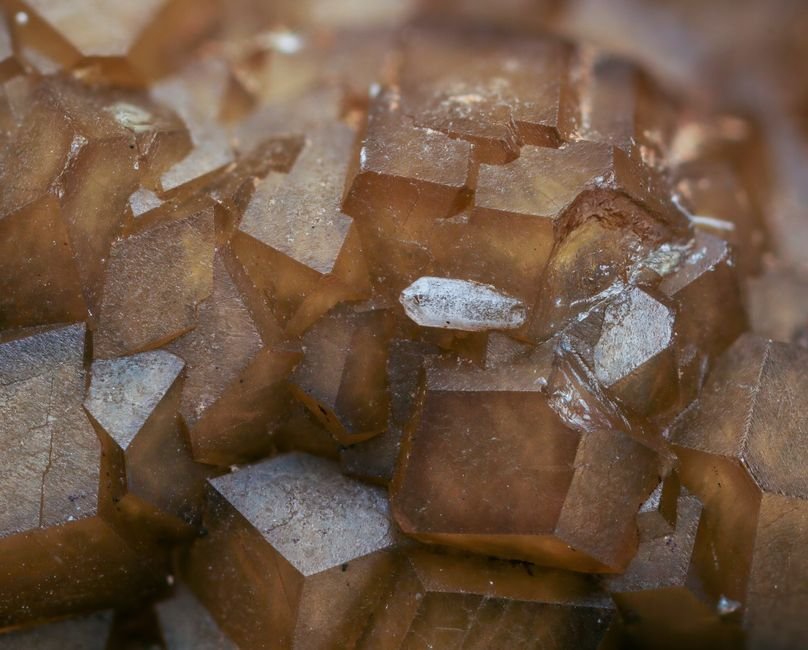
This is the part most crystal guides skip, and it’s the actual physical reason a “clean” split happens at all. Mineral cleavage refers to the way certain minerals break along predictable internal planes of weak atomic bonding, rather than breaking randomly like glass. Calcite is a textbook example: it has rhombohedral cleavage, meaning it reliably splits along three specific planes to form smooth-sided, rhomb-shaped pieces — the same predictable pattern geologists use to identify it in the field. Fluorite behaves similarly, splitting along four planes into octahedral shapes. Quartz, by contrast, has no true cleavage and instead fractures unevenly (called conchoidal fracture), which is why quartz points tend to shatter or chip rather than split cleanly in two.
In plain terms: if your crystal is a mineral with strong cleavage (calcite, fluorite, mica, halite), a clean split down the middle is often just the mineral doing exactly what its atomic structure predicts — not a random or especially rare event.
What the Spiritual View Says About a Clean Split
Within crystal healing traditions, a clean split is widely interpreted as something more significant than an ordinary break. Common readings include:
- Major energetic release — the idea that built-up energy inside the stone reached a point of completion and released evenly, producing a clean rather than jagged break.
- Completion of the crystal’s purpose — some practitioners see a clean split as the crystal signaling that its work with you has finished.
- A dividing message — a few traditions interpret the split as the crystal intentionally separating to serve two purposes, two people, or two places at once.
These interpretations are widely held within crystal communities, but they’re beliefs, not verifiable facts — there’s no way to measure “energy release” the way you can verify a cleavage angle under a microscope.
Myth: Does Every Clean Split Carry Deep Meaning?
Not necessarily. This is the most important corrective for this topic: a clean split is very often simply mineral structure at work, especially with calcite, fluorite, halite, or mica — all minerals known for strong, predictable cleavage. Treating every clean split as automatically profound overlooks the much more common, purely physical explanation. That doesn’t make the spiritual interpretation wrong for you personally — it just means the split alone isn’t evidence of anything beyond physics unless other context (timing, circumstances, your own intuition) supports a deeper reading.
What To Do With a Split Crystal (Troubleshooting Steps)
- Check whether the split follows a natural cleavage line. A smooth, flat, geometric-looking break (especially in calcite, fluorite, or mica) is almost certainly cleavage. A jagged, irregular break is more likely impact damage rather than the mineral’s natural structure.
- Decide whether to keep both halves together or separate them. There’s no requirement either way — some people keep both pieces as a matched pair, others separate them intentionally (gifting one, using one in a grid, keeping one at home and one elsewhere).
- Cleanse if that’s part of your practice. As with any other break, a cleanse afterward is optional and mostly serves as a personal reset rather than a physical necessity.
Should I Keep Both Halves?
There’s no correct answer — this comes down entirely to personal preference:
- Keep them together if you like the idea of a matched pair, or if the two halves feel meaningful placed side by side (some use them at opposite ends of a room or altar).
- Separate them if you want to gift one half to someone, use each piece in a different context (home vs. travel, one grid vs. another), or simply prefer working with a smaller stone.
- Repurpose one or both into jewelry, a grid, or décor if neither half feels meaningful as a stand-alone piece anymore — what to do with a broken crystal walks through every option.
Does Splitting Double a Crystal’s Energy?
No — not in any way that’s been measured or verified. This is a common belief within some crystal circles (the idea that two pieces each carry the “full” energy of the original, effectively doubling its reach), but it’s not something science can confirm, since crystal “energy” itself isn’t a measurable physical quantity in this context. If this idea resonates with your practice, there’s nothing wrong with using it that way — just hold it as a personal or traditional belief rather than an established fact.
A Caution: Don’t Base Major Decisions on a Split Alone
It’s worth being direct about this: a crystal splitting — even in a way that feels significant — shouldn’t be the deciding factor in a major life decision (ending a relationship, quitting a job, moving) without other supporting reasoning. Reading unusual significance into a coincidental event and then selectively noticing “confirming” details afterward is a well-documented cognitive pattern — confirmation bias — where people favor information that supports what they already believe while overlooking contradicting evidence. Using a crystal split as one input alongside your own judgment is very different from treating it as the reason itself.
A Calcite That Split Along Its Cleavage Plane
A calcite piece splits cleanly in two after being dropped on a hard tile floor. Because calcite has rhombohedral cleavage, the split follows one of the mineral’s natural planes almost perfectly, leaving two smooth-edged pieces rather than jagged shards. The owner decides to keep one half on their desk and gift the other to a close friend going through a similar life transition — a personal, symbolic choice made after the fact, not a requirement of the split itself.
Making Sense of Your Own Split Stone
- Keep both halves if you like the idea of a paired set or the pieces feel meaningful together.
- Gift one half to someone if the split feels like an invitation to share the stone’s meaning.
- Repurpose either piece separately — jewelry, a grid, or décor — based on whichever option feels most useful to you.
Questions About Crystals Splitting in Half
Should I keep both halves of a split crystal?
There’s no rule requiring either choice. Keeping them together, separating them, gifting one, or repurposing both are all common and equally valid depending on personal preference.
Does splitting double the energy of a crystal?
This is a belief held in some crystal circles, not a scientifically measurable effect. If it’s meaningful to your practice, there’s no harm in treating each half as carrying the stone’s full significance.
Why did my crystal split so cleanly instead of shattering?
It likely followed a natural cleavage plane — a built-in structural weakness in minerals like calcite, fluorite, mica, or halite. This is a normal physical property of the mineral, not necessarily a sign of anything unusual.
Is a clean split more spiritually significant than a jagged break?
Within many crystal traditions, yes — a clean split is often read as more meaningful than a rough break. This is a traditional interpretation, though, not an established fact, and plenty of clean splits are simply mineral cleavage at work.
Can I use both halves of a split crystal separately?
Yes. Each piece is fully usable on its own — for meditation, décor, jewelry, or grids — the same way any other crystal piece would be. (More on that in can you still use a broken crystal.)