Last Updated on August 19, 2026 by Umar Farooq
Four things turn rose quartz white, and they are nowhere near equally likely. The surface can be scuffed to a matte haze while the colour underneath is untouched. A dye can wash out. Light can bleach it — though rose quartz resists light far better than amethyst does. Or the stone was never rose quartz. Which one you have decides everything, because one of the four is completely repairable and three are not.
One test splits the field before you do anything else. Wet the stone. If the pink floods back while it is wet and drains away as it dries, the colour is still there and you are looking at a scratched surface. If it stays pale when wet, the colour itself has gone.
Cause 1: Light Bleached It — Real, but Less Likely Than You’d Think
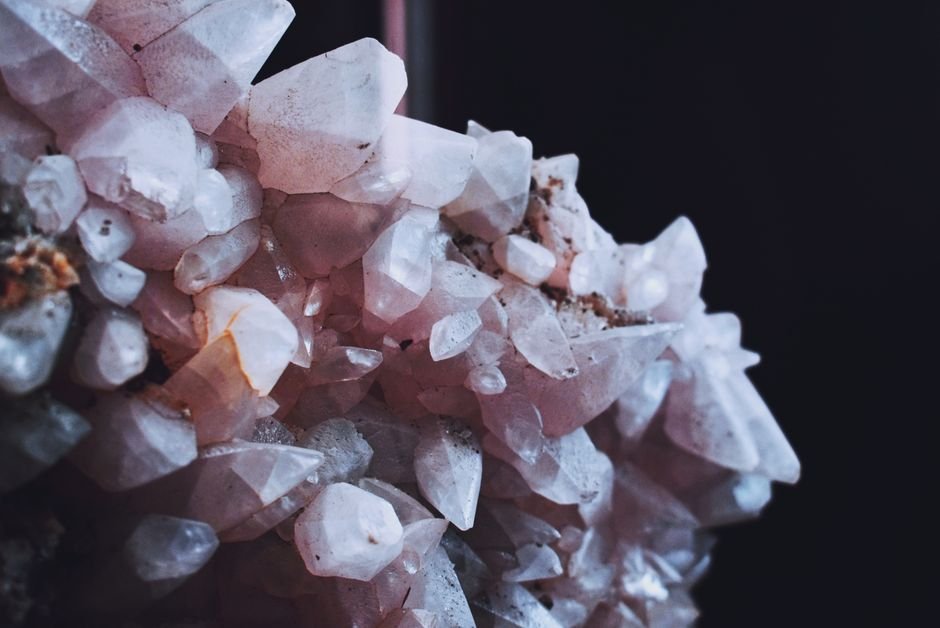
Rose quartz is silicon dioxide, the same mineral as clear quartz, and the colour does not come from the quartz at all. (If the stone has gone hazy rather than pale, a cloudy crystal is a separate problem with its own fixes.) It comes from microscopic fibrous inclusions of a mineral closely related to dumortierite — nanofibres 0.1 to 0.5 micrometres wide, suspended through the stone and identified by Goreva, Ma and Rossman in 2001. An iron–titanium charge transfer inside those fibres absorbs light around 500 nanometres, and that is your pink. It is also why rose quartz is cloudy rather than clear.
That matters, because inclusion colour is far tougher than colour-centre colour. Amethyst’s purple is a fragile arrangement of iron atoms that UV simply resets — which is why amethyst turning white is a sunlight problem almost every time. Rose quartz is not built that way. GIA calls it generally stable in light and heat, and the colour survives heating to around 500°C.
Two exceptions matter. Some material does pale in daylight — rose quartz from certain deposits, Brazilian ones especially, is reported to lose colour in the sun, and you cannot tell which you bought. And transparent pink quartz is a different stone, coloured by aluminium and phosphorus colour centres created by natural irradiation, the same mechanism as amethyst. That variety is properly photosensitive.
So light is a fair answer if your stone lived on a south-facing sill for a year, or went out for weekly sun charging, and has gone evenly pale all the way through. Real fading is body-deep: look into a chip or a drill hole and the inside is as pale as the outside.
Cause 2: The Surface Is Scratched, Not Faded
This is the usual answer for tumbled stones and anything worn, and almost nobody suspects it — because a scratched stone does not look scratched. It looks cloudy. Fine scratches scatter light instead of transmitting it, and scattered light reads as white.
Rose quartz sits at 7 on the Mohs scale, so keys, scissors and cutlery (steel, 4 to 5.5) cannot touch it. The damage comes from subtler things:
- Household dust. Much of it is quartz sand, the same hardness, and equal hardness abrades perfectly well. Wiping a dusty stone with a dry cloth is essentially lapping it.
- Other beads. Every bead on a quartz bracelet is a 7 grinding against its neighbours all day.
- Harder stones sharing a jewellery box — topaz at 8, sapphire and ruby at 9, diamond at 10.
Dry salt is not the culprit, for what it’s worth: halite is 2 to 2.5 and cannot scratch quartz.
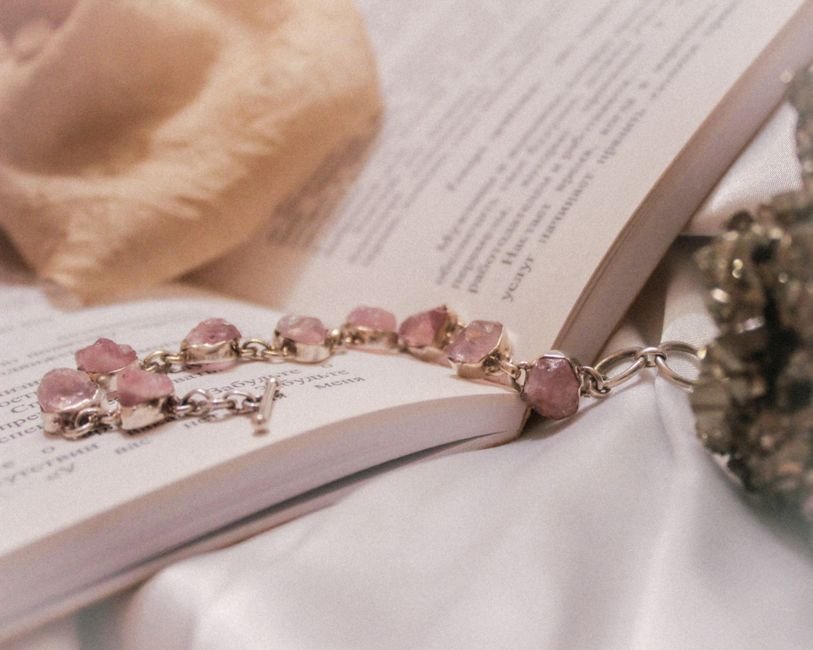
If your rose quartz bracelet turned white within a few months of daily wear, this is nearly always why — and it is the one cause that can be fully undone.
Cause 3: The Pink Was Dye, and the Dye Has Gone
A great deal of inexpensive rose quartz — especially even, candy-pink beads — is dyed white or milky quartz. The dye goes on the outside and soaks inward through the hairline fractures running through almost every piece.
That gives it a distinctive failure pattern: dye fails from the outside in, and it leaves the cracks pink. Smooth faces pale first, because the dye layer there is thinnest, while fractures stay saturated because that is where it pooled deepest. A white stone with pink lines running through it is dyed — the exact opposite of natural fading.
Natural rose quartz is soft, milky and unevenly coloured, rarely strongly saturated in a small bead — so vivid, uniform, edge-to-edge pink at a low price is a warning sign rather than a bargain. Fake vs natural rose quartz runs through the full set of checks, including the ones you can do in a shop before you pay.
Cause 4: It Was Never Rose Quartz
The last possibility is that the pink object is glass or resin, behaving exactly as glass and resin behave.
Glass is around 5.5 on the Mohs scale, which makes this the one case a scratch test settles outright: a steel point marks glass and will not mark quartz. It also warms in your hand within a couple of seconds, where quartz stays cold much longer.
Resin and plastic are too light for their size, softer again, and they yellow under UV — so a piece drifting toward a yellowish, plasticky white rather than a clean pale is a strong suspect. How to tell if a crystal is real covers the density and temperature checks.
Working Out Which One You Have
Bright indirect daylight, a 10x loupe or your phone’s macro mode, five minutes. Do it in order.
- Wet a small area with water or a smear of mineral oil. Pink returns, then fades as it dries → surface abrasion. No change → the colour has genuinely gone; keep going.
- Look at an unpolished edge, a chip, or inside a drill hole. Pale all the way through → fading. Deep pink inside, white outside → dye loss or abrasion.
- Read the cracks. Fractures pinker than the stone around them → dye. Same shade or paler → natural colour.
- Loupe the surface. Fine scratches crossing in all directions → abrasion. Round gas bubbles, curved swirl lines or a mould seam → glass or resin.
- Swab test. Rub firmly with a damp white cotton bud on a hidden spot, then repeat with acetone on a fresh bud. Any pink transfer → dyed. Pick a spot that will not show, since acetone also lifts resin coatings.
- Scratch test last, and only somewhere hidden — inside a drill hole or on the base. A steel point that marks it easily means glass or resin.
Why Is My Rose Quartz Turning Yellow Instead?
White is colour lost from inside. Yellow, tan or rusty is almost always iron staining added to the outside.
Quartz is chemically inert, but rose quartz is riddled with hairline fractures, and those are open channels into the stone. Iron-bearing water, contact with steel or oxidising jewellery findings, damp storage, a spell buried in the garden — all leave iron oxides in the cracks and surface pits, which is why yellowing follows the fracture lines rather than spreading evenly. On worn beads there is a duller version: skin oils, hand cream and soap film in the surface pores.
What that indicates matters — moisture is reaching open fractures, and a fractured stone that keeps getting wet can eventually split along those lines. Oils and soap film come off with warm soapy water and a soft brush. Iron staining is harder; lapidaries use oxalic acid, a poison and not a kitchen job. Skip ultrasonic and steam cleaners either way.
What Crystal Traditions Read Into a Whitening Rose Quartz
Plenty of people searching this want the physical answer and the interpretive one, so here is that side given properly.
Within crystal healing communities, the change is read three main ways. The first is absorption and transmutation: rose quartz is worked with for grief, heartbreak and self-compassion, and the whitening is taken as evidence it carried a heavy load for you, calling for a thorough cleanse and a long rest rather than replacement. The second is completed purpose — the stone finished what it came into your life to do, and the fading marks an ending rather than a fault. The third is a heart-chakra shift, pink moving to white read as the stone’s focus rising from the heart centre toward the higher heart or crown, from personal love toward unconditional love.
These are interpretive frameworks rather than mechanisms, and none of them predicts which stone whitens or when. The bracelet you wear daily dulls and the identical one in the drawer does not, and that pattern tracks abrasion precisely. What the interpretations answer is a question mineralogy has nothing to say about: what the change means to you. If the stone feels different as well as looking different, can crystals lose their power and how to recharge a crystal that feels dead take up that side.
What Can Be Brought Back and What Cannot
Scratching: fully recoverable, which matters because it is the most common cause. Re-polishing removes the scratched skin and the colour comes back permanently, not just while wet. Tumbled stones can go through the final polish stage of a rock tumbler, and a lapidary can repolish a cabochon in minutes. It takes off a thin layer, so sharp edges soften slightly, and drilled beads are fiddly enough that the labour often outruns the value of the bracelet.
Fading: not at home. Colour centres can be restored by irradiation — GIA notes rose quartz is occasionally treated with radiation to intensify its colour — but that needs a licensed facility and costs more than most specimens are worth. Treat it as permanent. Fading does stop the moment the exposure does, so moving the stone today freezes it where it is.
Dye loss: no, and re-dyeing just recreates the problem a year later. If the piece is glass or resin there is nothing to repair.
Keeping the Pink in the Rose Quartz You Still Own
Nearly all of this is about abrasion and moisture, because those are what actually get rose quartz.
- Store beads and tumbles so they do not touch — soft pouches or a compartment box. A bowl of loose crystals is a slow tumbler.
- Keep it away from topaz, sapphire, ruby and diamond jewellery, the only common stones hard enough to cut it decisively.
- Take bracelets off for washing up, gardening, the gym and cleaning, and before hand cream or sunscreen.
- Never dust a dry stone with a dry cloth. Rinse first, then dry — dragging grit across the surface is how the haze builds.
- Keep it off windowsills anyway. The risk is lower than for amethyst but not zero, and moonlight, a selenite plate or sound cleansing does the same ritual job with no UV.
Questions About Rose Quartz Turning White
Why is my rose quartz bracelet turning white?
Abrasion, in the great majority of cases. The beads grind against each other and against every surface your wrist touches, and a few months of that leaves a frosted skin while the colour underneath stays untouched. Wet one bead — if the pink comes back, a repolish will restore it.
Does rose quartz fade in sunlight?
Some of it does. Common massive material is coloured by dumortierite-related inclusions and is comparatively light-stable, which is why GIA calls rose quartz generally stable to light. But material from certain deposits pales in daylight, and transparent pink quartz fades readily. Since you cannot tell which you own by looking, keeping it out of direct sun is the sensible default.
Why is my rose quartz turning white — is there a spiritual meaning?
The common readings are that the stone absorbed and transmuted heavy emotional energy for you, that it completed what it came to do, or that its focus shifted from the heart centre toward higher, less personal love. These sit alongside the physical checks rather than replacing them — and the physical check is worth doing first, because if the cause is abrasion the stone can be brought back.
Can white rose quartz turn pink again?
If the whiteness is surface scratching, yes: re-polishing restores it completely. If the colour faded or the dye washed out, no. No cleansing, charging routine or soak restores lost colour, because the change happened inside the stone rather than on it.
Is my rose quartz ruined if it has gone white?
Not structurally — same mineral, same hardness, no crack and no safety issue. What it lost is appearance. Within crystal traditions a pale stone is worked with exactly as before, since colour is not where practitioners locate a stone’s properties.
Sources referenced for the mineralogy in this guide: Rose quartz — colour origin and the pink quartz distinction (Wikipedia), Rose Quartz Description — Gemological Institute of America, and Goreva, Ma & Rossman (2001), “Fibrous nanoinclusions in massive rose quartz,” American Mineralogist. Spiritual interpretations are presented as belief held within crystal healing communities, not as established fact.