Last Updated on August 19, 2026 by Umar Farooq
Short answer: moisture. Selenite is gypsum — calcium sulfate dihydrate, CaSO₄·2H₂O — and gypsum genuinely dissolves in water, at around 2 to 2.5 grams per litre at room temperature. It also sits at 2 on the Mohs hardness scale, softer than your own fingernail. Together those two facts make a mineral that ordinary household damp can visibly wreck.
Chalky, flaking and oily are not three separate faults. They are three stages of the same process, usually met in that order: a slick or greasy surface first, then a dull white bloom, then fibres lifting away from the body of the stone.
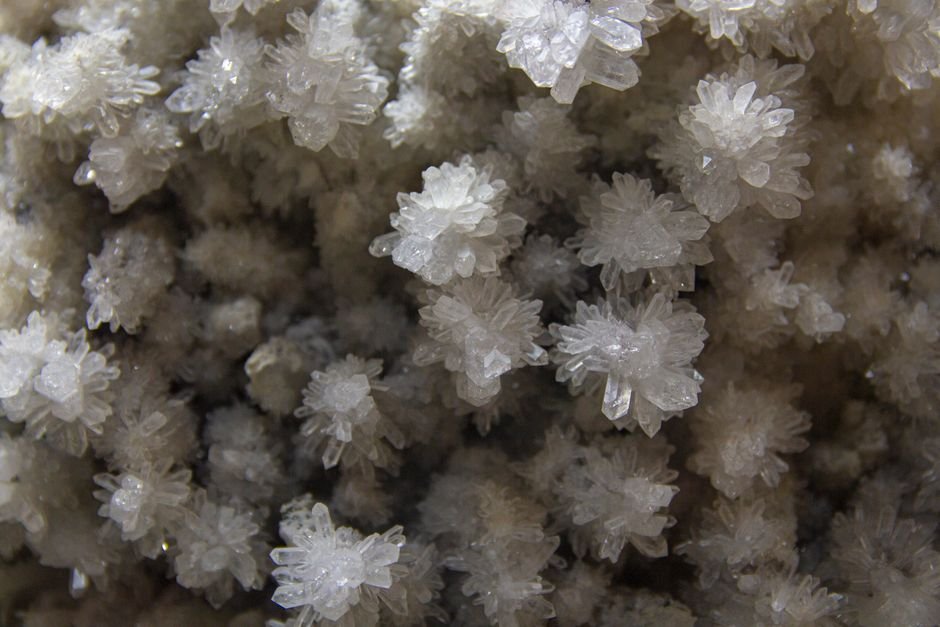
If your piece is a white silky tower, wand or lamp, it is almost certainly satin spar rather than true selenite. That changes nothing here: both are gypsum, and both dissolve.
The Three Ways Moisture Reaches Your Selenite
Almost nobody soaks a selenite deliberately. Moisture arrives by three routes, and usually the owner was following advice given in good faith.
Direct rinsing. “Cleanse your crystals under running water” is the most repeated instruction in beginner crystal care, and for selenite it is destructive. Thirty seconds under a tap removes a microscopic layer, and that layer is where the polish lived. Soaking overnight is far worse.
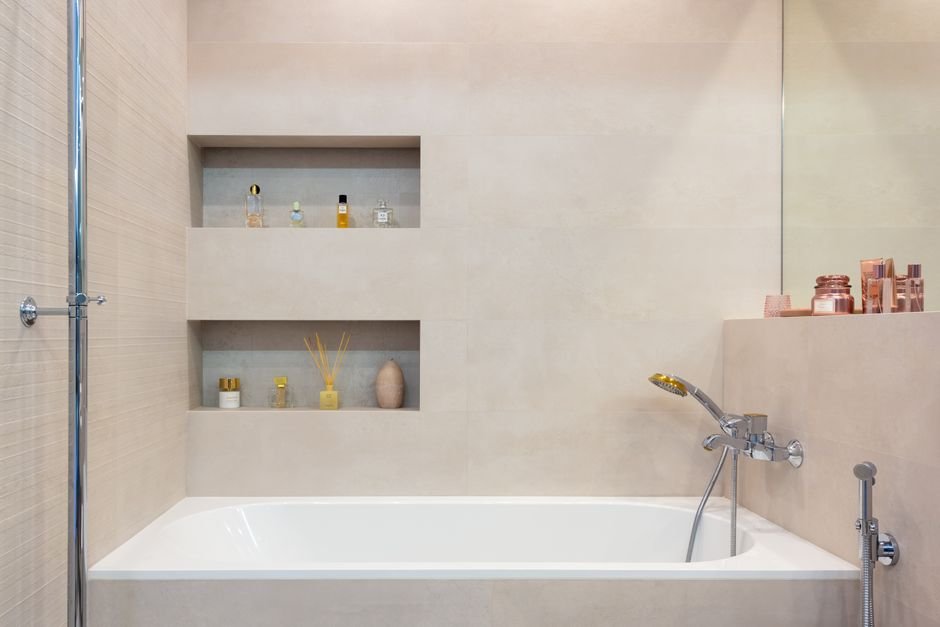
Humid rooms. Bathrooms, kitchens, basements, and anywhere within a metre or two of a running humidifier. This is the route people never suspect, because the stone never touched liquid water. A selenite tower on a bathroom shelf can degrade in months.
Damp hands. Skin carries water, salt and sebum, so a palm stone handled daily takes repeated damp contact on a Mohs 2 surface. The giveaway is a stone dulled and tacky exactly where the fingers rest, still bright everywhere else.
Why Is My Selenite Oily When It Never Touched Water?
This is the case that makes no sense to most owners, and it has a real answer.
Gypsum is hygroscopic — it pulls water out of humid air. Selenite has perfect cleavage along one plane, the {010} face, which is why it splits into clean sheets, and that surface is chemically active. Studies of water on the gypsum (010) face, using vibrational spectroscopy alongside first-principles simulation, show hydroxyl groups on the exposed surface binding water molecules straight out of the atmosphere into an ordered adsorbed layer. Raise the humidity and a second layer forms on top of the first.
That film is real water sitting on your stone — far too thin to see, thick enough to feel, and behaving differently from ordinary bulk water. It is more ordered and slower-moving, which is part of why it reads as slick or greasy rather than simply wet.
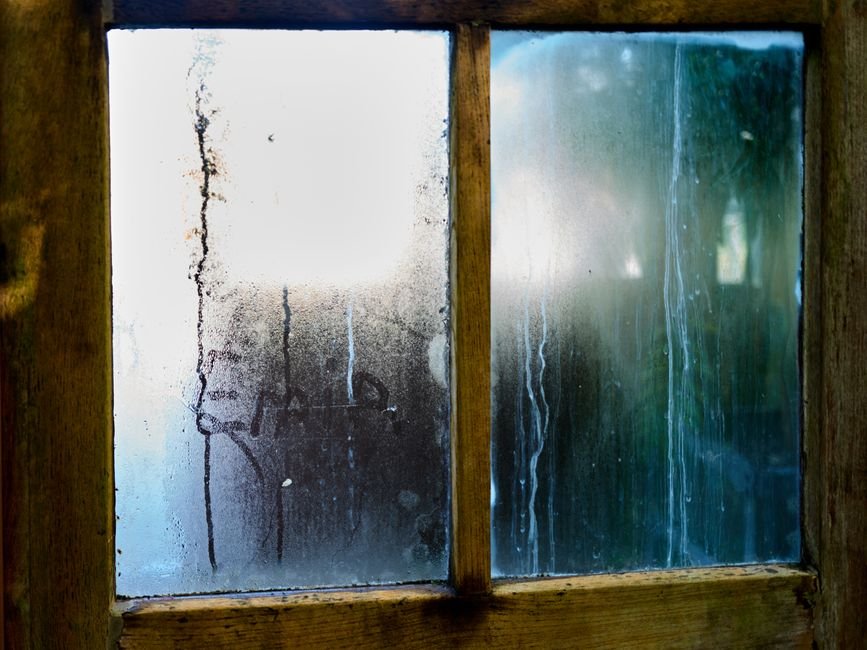
Two things compound it. The film starts the slow surface dissolution described below, and dissolved gypsum in a thin film is faintly slippery in its own right. And a soft, porous surface holds skin oils, hand cream, diffuser oil and cooking aerosols, none of which wipe cleanly off a stone that has lost its polish.
So an oily selenite is not a fake and not something the seller coated. It is usually a real gypsum specimen in a room too damp for it.
Why Is My Selenite Chalky?
Chalkiness is surface dissolution followed by recrystallisation — what happens once that water film has been present for a while.
Water in contact with gypsum takes a small amount of calcium sulfate into solution. When it evaporates, that material comes back out — but not as the polished face it came from. It precipitates as a mat of tiny, randomly oriented crystals. A polished surface reflects light one way and looks glassy; a field of microscopic crystals scatters it every direction, and scattered light reads as dull, powdery white. That is the bloom, and it is why a rinsed selenite looks worse dry than it did wet.
Repeated wet-dry cycles do more harm than one long soak: each leaves the surface more open and more absorbent, so the next runs faster.
Why Is My Selenite Flaking?
Flaking is the structural stage, and it follows the mineral’s geometry.
Gypsum has perfect cleavage in one direction: stacked layers held to each other by weak hydrogen bonding, far weaker than the bonds inside each layer. That is a fault line built in from the start. Satin spar takes it further — it grew as parallel fibres, which is what gives it the silky sheen, and those fibres separate with very little encouragement.
Moisture penetrating the cleavage planes dissolves material from between the layers, weakening what was already the weakest bond in the stone, and the layers lift. On a satin spar tower this shows as hair-fine fibres peeling from the surface, sometimes in silky sheets that come away when brushed. On a bladed specimen it looks more like pages separating from a book.
Flaking means water has got into the body of the piece, and that is where the damage stops being cosmetic.
Why Is My Selenite Turning Yellow or Brown?
Three causes, easy to tell apart once you know the signs.
Iron staining. Gypsum forms in evaporite deposits alongside iron-bearing minerals, and iron oxide gives the tan, rust and honey tones seen in raw material and desert rose. If the colour follows internal banding, or sits down in the fibres rather than on the outside, it was always there — only now visible as the white surface dulls.
Dust bonded into a damp surface. The common one, and it is grime rather than mineralogy. Dust, cooking grease, candle soot and incense residue settle on a surface made tacky by adsorbed moisture, and the next humid cycle glues them in. The even grey-yellow cast that results will not brush off, because it is in the roughened layer rather than on top of it.
Adhesive and backing bleed. Lamps, charging plates and slabs are usually mounted with hot-melt glue, epoxy, or a felt or cork pad. Those adhesives yellow with age and warmth, and gypsum is porous enough to wick the discolouration upward. If your selenite is turning brown from the bottom, in a halo around its fitting, that is the source — not the stone.
Why Did My Selenite Break So Easily?
Because Mohs 2 is genuinely, unusually soft. A fingernail is about 2.5 on the same scale, so you can scratch selenite with your own hand. A coin, a key, a ceramic dish, the zip on a bag — everything ordinary in a household is harder than your stone, which is why selenite breaking and marking is so routine.
Add perfect one-directional cleavage and a long thin shape, and a selenite wand is close to the most fragile object most people own. It does not need to be dropped: pressing on the middle while gripping both ends, or tightening a wire wrap, snaps one cleanly along the cleavage, and a wand already softened by moisture goes at a fraction of that force. If yours came apart with no impact at all, why a crystal chips without being dropped covers the wider question.
Is Any of It Reversible?
Honestly: the polish and the structure are not recoverable at home. A chalky bloom cannot be persuaded back into a smooth face, and separated layers do not rebond. Oil or wax makes the surface look temporarily darker and wetter, then traps the next round of dust.
What drying does is stop the progression. Stand the piece in the driest room you have, on something absorbent, and give it days rather than hours — a thick tower holds moisture past the point it feels dry. No hairdryer, radiator or oven: gypsum starts losing its water of crystallisation when heated, and forcing that turns a damaged stone into a crumbling one. Then remove the cause, or it happens again.
Then decide. Dulled but solid is worth keeping — it works as it did, it just no longer shines. One actively shedding fibres will keep shedding, and retiring it is reasonable. What to do with a broken crystal and whether to replace a broken crystal go through that decision, and whether broken crystals can be repaired is worth reading before you reach for glue — on gypsum, adhesive stains.
Cleansing Selenite Without Water
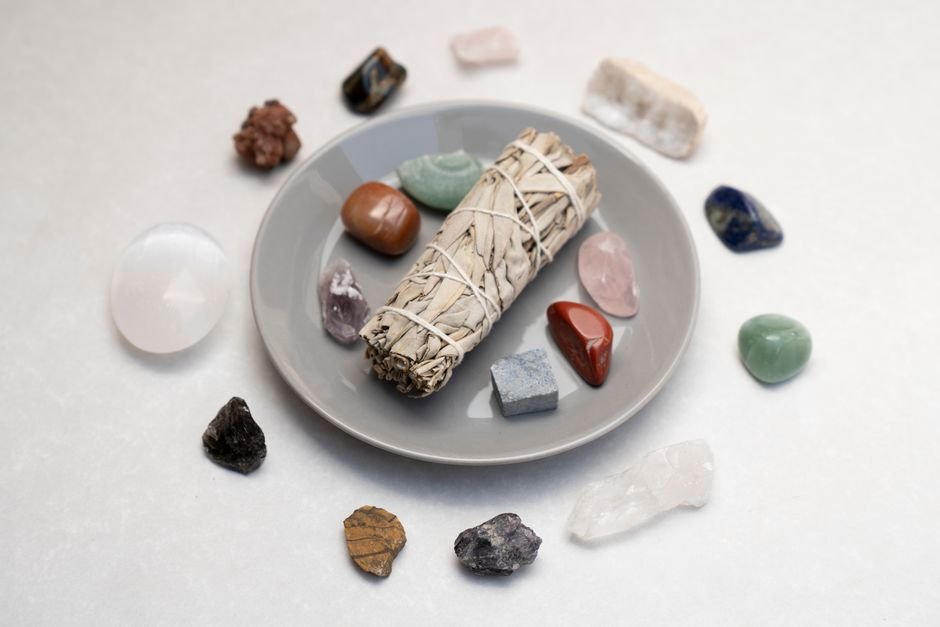
Smoke — sage, palo santo or incense; nothing but air contacts the stone. Sound — a singing bowl, bell or tuning fork held nearby, safest of all for a fragile piece. Moonlight — on an interior windowsill; never outside, where dew and morning condensation are exactly what you are avoiding. Breath and intention — costs nothing, touches nothing. Dry dusting — a soft brush worked along the fibres, never across them, and never a damp cloth.
Avoid dry salt: it is abrasive, hygroscopic itself, and holds moisture against the stone. If cleansing has become a source of anxiety, signs you’re using your crystal wrong is a useful reset.
What a Deteriorating Selenite Is Taken To Mean
Within crystal healing communities selenite is regarded as a self-cleansing stone that clears others, and one that goes cloudy or crumbly is usually read as having taken on more than it could carry — the change treated as evidence of the work it did. A stone that falls apart is often read as having finished its purpose with you.
Those are interpretive frameworks rather than mechanisms, given here as what people in the tradition believe. The physical explanation is the one that predicts what happens — the bathroom tower goes chalky, the bedroom one does not — and that is the version that protects the rest of the shelf. If the collection feels flat rather than looking damaged, recharging a crystal that feels dead covers that.
Stones That Fail the Same Way as Selenite
If selenite has degraded on a shelf, check what is next to it.
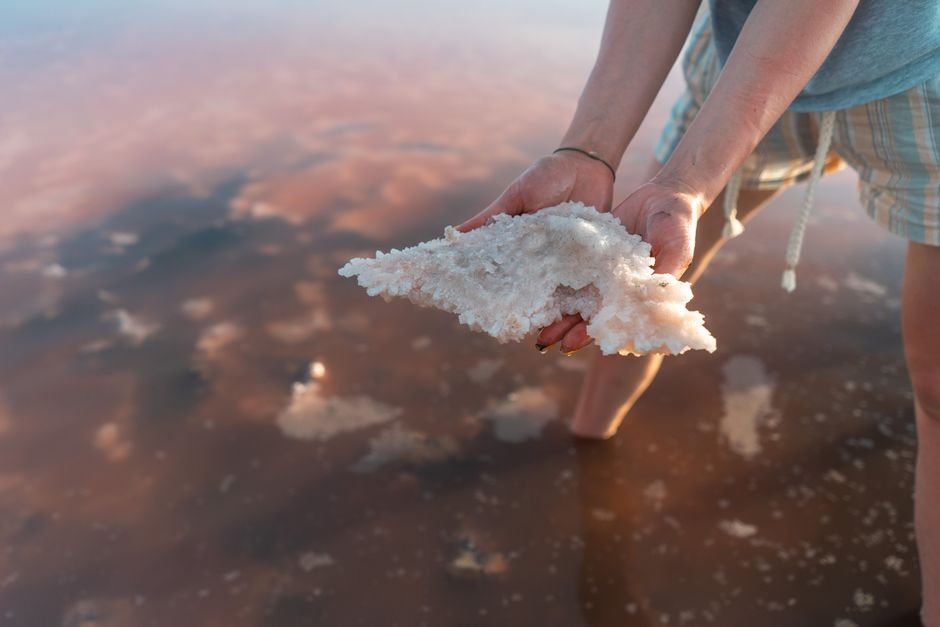
Satin spar is the same mineral. Because most sellers label satin spar as selenite, the majority of “selenite” towers, lamps, wands and charging plates in circulation are satin spar — fibrous gypsum, Mohs 2, identical solubility.
Halite is rock salt, sodium chloride, Mohs 2 to 2.5. Not merely water-soluble but deliquescent: in a humid room it pulls enough moisture from the air to wet itself and eventually sit in a puddle of its own brine.
Angelite is anhydrite, calcium sulfate without the water — gypsum’s dry form. Water does not just dissolve it, it converts it: anhydrite rehydrates back toward gypsum and expands as it does, chalking a polished piece.
Celestite is strontium sulfate, Mohs 3 to 3.5. Its problem is different — not solubility, but blue geode blades brittle enough to snap under a fingertip.
The rule underneath all of it: soft sulfates and any halide stay away from water. Quartz, agate, jasper and obsidian tolerate a rinse. Gypsum does not.
Questions About Chalky, Flaky and Oily Selenite
Does a chalky selenite still work?
Within crystal healing traditions, yes — the mineral is unchanged, and practitioners do not locate a stone’s properties in its polish. Physically it is still gypsum; what it lost is surface finish. A piece shedding fibres is a different case, less because it stopped working and more because it is disintegrating.
Can I seal selenite to protect it?
You can, and most people regret it. Resin, wax and mineral oil all darken gypsum, and because the stone is porous the finish soaks in unevenly and cannot be removed. It also seals in whatever moisture is already there.
Is my selenite fake because it feels oily?
Almost certainly not. An oily feel is characteristic of genuine gypsum in a humid room. If anything it is weak evidence the piece is real, since the usual substitutes are harder materials that do not behave this way.
Does selenite dissolve completely if I leave it in water?
Given enough water and time, yes. Gypsum’s solubility is low but not zero, and a submerged piece progressively loses material, going soft and rounded at the edges first. A few minutes under a tap already costs you the polish.
Mineralogy sourced from Gypsum — composition, solubility, hardness and cleavage (Wikipedia), Selenite, satin spar and desert rose varieties (Wikipedia), and the Mohs hardness scale — U.S. National Park Service. Spiritual interpretations are presented as belief within crystal healing communities, not as established fact.