Last Updated on August 19, 2026 by Umar Farooq
There are four physical routes a crystal takes to black, and which one applies depends entirely on the stone. Iron and sulphide minerals oxidise. Porous stones soak up skin oil, lotion and smoke residue. Heat converts pale iron compounds into dark ones. And coatings — aura finishes, dye, wax — break down and go patchy. Three of those four wipe or wash off. One does not.
So identify the stone first, because “my selenite went dark” and “my pyrite went dark” have almost nothing in common.
Route One: Iron and Sulphide Minerals Oxidising
This is the only route where the mineral itself genuinely changes, and it covers few stones.
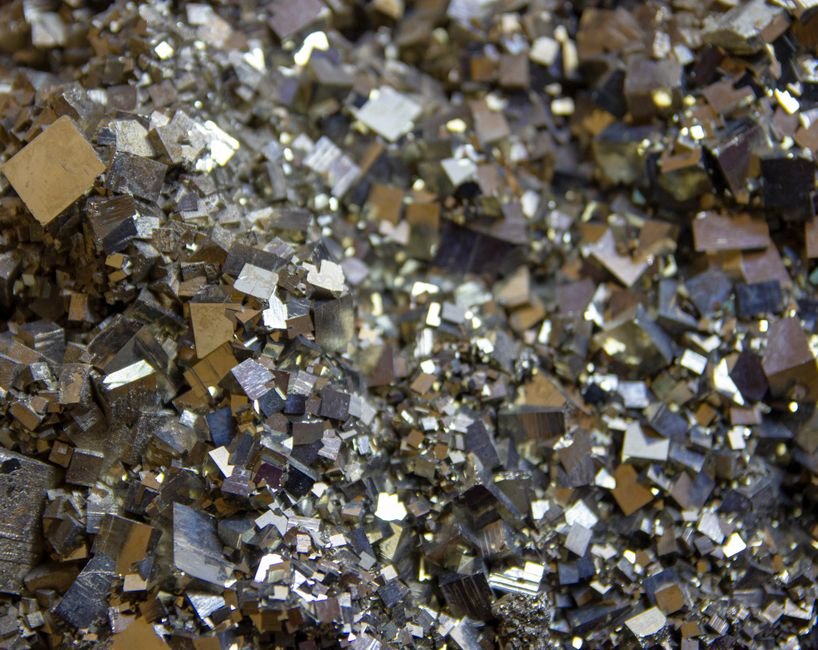
Pyrite is the headline case. It is iron sulphide, FeS₂, and it is not stable in the conditions we keep it in: exposed to atmospheric oxygen plus moisture it decomposes into iron oxyhydroxides and sulphuric acid, which collectors call pyrite decay. It begins as a dulling of the brassy shine, moves to a grey-brown film, and in bad cases the specimen crumbles and smells faintly sulphurous. Humidity drives it — a pyrite cube in a damp bathroom degrades in a season, the same cube in a dry sealed box lasts decades. Lapis lazuli carries pyrite as its golden flecks, and those tarnish while the blue stays perfect.
Hematite is the exception people expect to find here. It is Fe₂O₃, already fully oxidised, so it cannot rust further — a mirror-polished bead going dull grey-black is micro-scratching and skin oil. And check the setting before blaming the stone: silver reacts with sulphur in air and on skin to form black silver sulphide, so a darkening ring often has a clean gemstone in a tarnished mount.
Route Two: Skin Oils, Lotion and Smoke Residue
The most common cause by a wide margin, and reversible.
Softer, more porous stones — anything under about Mohs 4 — have surfaces full of microscopic pits and grain boundaries, and sebum, hand cream, sunscreen and kitchen grease migrate into them. Fresh, the film is invisible. Over months it accumulates, oxidises, traps dust, and reads as a grey to near-black darkening heaviest where your fingers go.
Smoke is the underrated half. Cleansing with sage, palo santo or incense deposits carbon particulate and unburnt oils straight onto the stone. Smudging a crystal weekly for a year lays down a real film, and it settles into crevices first — which is why a cluster darkens between the points first.
The tell is location. Grime follows handling and gravity — fingertip zones, the base a piece sits on, the recesses of a carving, the drill holes of beads — never the stone’s internal colour zoning.
Route Three: Heat Darkens Some Stones Instead of Fading Them
Most people know heat and light fade crystals — which crystals fade in sunlight covers that side in full. Less well known is that heat pushes some stones the other way.
The mechanism is iron again. Pale iron hydroxides such as goethite dehydrate when heated and convert to hematite, which is deep red-brown to near-black — the basis of the carnelian and agate heat-treatment industry, where dull yellowish material is baked into rich red-brown. Any iron-stained agate, jasper, carnelian or included quartz can drift darker with sustained heat.
Then the blunt version. A stone next to a burning candle collects soot. One on a radiator shelf or a sunlit dashboard bakes the oils from Route Two into a brown varnish that no longer rinses off. Amber, being fossilised resin, darkens with warmth over years. And a hot tap rinse opens micro-fractures that then fill with grime.
Route Four: A Coating, Dye or Wax Finish Breaking Down
Plenty of what sells as crystal has something on it, and when that something fails it usually fails toward dark.
Aura quartz — angel aura, titanium aura, flame aura — is ordinary quartz carrying a vapour-deposited film of metal atoms measured in nanometres. Handling and cleaning wear it through unevenly, so worn zones go grey, bronze or blackish while untouched areas keep their iridescence. Patchy dark on a rainbow stone is nearly always this.
Dyed stones darken as the dye degrades and concentrates. Dye sits in surface-reaching fractures, so the cracks go inky while the flat faces pale — the reverse of how natural colour behaves. How to tell if a crystal is real covers the rest of those checks.
Waxed and oiled stones are everywhere — tumbled material, most commercial turquoise, plenty of malachite and jade. Wax grabs dust and skin oil, then yellows and browns with warmth.
What Black Actually Means on Each Stone
Amethyst. Amethyst does not darken at home. Its purple comes from iron colour centres created by natural irradiation, and household conditions only remove that colour — which is why amethyst turning white is the far commoner complaint. Black amethyst is grime between cluster points, naturally dark material carrying hematite or goethite inclusions, a tarnished silver setting, or dyed quartz that was never amethyst.
Rose quartz. Its pink comes from microscopic fibrous inclusions related to dumortierite, and like amethyst it fades in light rather than darkening. It is massive and shot through with micro-fractures, which makes it a sponge for oil — a daily-worn bracelet going murky grey-brown is sebum in those fractures, every time.
Selenite. Gypsum, CaSO₄·2H₂O, and at Mohs 2 softer than a fingernail — anything you touch it with scratches it, and every scratch holds dirt. It is also slightly water-soluble, so a damp cloth dissolves the surface and cements the grime in. Selenite goes yellow, orange or dull grey far more often than black; real black means smoke residue or mould from damp storage.
Clear quartz. At Mohs 7 it resists almost everything, so darkening is nearly always on it rather than in it — soot, a failed aura coating, or grime in the fractures of a crazed piece. Black specks that were always there are tourmaline, hematite or carbon inclusions.
Howlite. A calcium borosilicate, Mohs 3.5, white with grey-black webbing, and porous enough that the trade dyes it blue and sells it as turquoise. That porosity means untreated howlite greys with handling faster than anything else here.
The Wipe Test: Surface Grime or Structural Change
Two minutes settles it. Pick an inconspicuous spot — the base, the back of a bead. On stones of Mohs 4 and above, dampen a white cotton cloth with distilled water and rub firmly for ten seconds. On selenite, howlite and anything softer, keep it dry.
Look at the cloth, not the stone. Grey or brown transfer means Route Two: a film, and more cleaning removes it. Coloured transfer — pink, purple, blue — means dye breaking down. If nothing transfers, try a cotton bud with isopropyl alcohol, on hard stones only; never on selenite, howlite, turquoise, amber, opal or anything coated.
If the dark survives that, look at where it sits. Following the surface — pits, crevices, the high points that get handled — means grime, just stubborn. Following the stone’s internal structure, in bands or clouds visible under the polish rather than on it, means structural, and no cleaning reaches it. Dull as well as dark points to Route One.
What Crystal Traditions Read Into a Stone Turning Black
This question carries real interpretive weight, and it deserves a straight account.
The dominant reading within crystal healing communities is that the stone absorbed and held negative energy — that it took on something heavy from you, a person or a place, and the darkening is that load made visible. Black tourmaline, amethyst and clear quartz are all described as protective or transmuting stones, so darkening in one of those is read as the stone doing what it was placed there to do.
A second, closely related reading is that the stone finished a protective job and reached the end of its usefulness — completion rather than damage, with the practice being to thank it and retire it. A third takes darkening as saturation, calling for deep cleansing by burial or running water, after which the colour is expected to return.
These are interpretive frameworks. They answer what the change means to you and whether to keep working with the stone, which is a real question with no mineralogical answer.
What they do not do is predict. The physical account does: the pyrite in the humid bathroom degrades and the one in a dry box does not, the bracelet worn daily darkens and the identical one in a drawer does not, selenite darkens faster than quartz because it is Mohs 2 against Mohs 7. Holding both readings is fine — just check the physical one first, because if a stone is darkening physically, everything sharing its shelf is in the same conditions. If the collection feels flat rather than looks dark, see can crystals lose their power and why a crystal suddenly stops working instead.
What Cleans Off and What Doesn’t, by Hardness
Hardness decides your method, so the Mohs scale is the tool.
Mohs 7 and up — quartz, amethyst, rose quartz, agate, jasper. Warm (not hot) water, mild soap, soft brush; alcohol for stubborn oil films. Grime comes off.
Mohs 5 to 6 — labradorite, moonstone, lapis, obsidian. Barely damp cloth, mild soap, no soaking. Lapis is often waxed, and alcohol strips that finish.
Mohs 3 to 4 — malachite, howlite, calcite, fluorite. Dry cloth first; damp not wet if you must, then dry at once. Oil deep in howlite may never come out.
Mohs 2 and below — selenite, satin spar. Dry only: soft brush for dust, microfibre for the rest. Water permanently etches the satin sheen.
Never cleanable: oxidised pyrite, worn-through aura coating, degraded dye, heat-converted iron staining — in each the material itself has changed. A sealed box with a silica gel packet halts pyrite decay where it stands, and since that decay makes a little sulphuric acid, store the piece away from paper and other specimens.
For the habits behind most of this, signs you’re using your crystal wrong and what blocks crystal energy cover the routines worth revisiting.
Questions About Crystals Turning Black
Why is my amethyst turning black instead of white?
Amethyst’s colour cannot deepen at home — light and heat only remove it. Near-black amethyst is naturally dark material with hematite or goethite inclusions, grime packed between cluster points, a tarnished silver setting, or dyed quartz whose dye is degrading. The wipe test on the base answers it in seconds.
Why is my rose quartz turning black?
Almost certainly absorbed skin oil. Rose quartz is massive rather than single-crystal, so it is full of micro-fractures that hold sebum, hand cream and dust, and worn beads darken fastest at the drill holes. Warm soapy water and a soft brush restore it safely at Mohs 7.
Why is my selenite turning black?
Selenite is gypsum at Mohs 2 — softer than a fingernail. Handling scratches it, the scratches fill with dirt, and it partly dissolves in water, which cements grime into the surface. True black usually means smoke residue or mould from damp storage, and it must be cleaned dry.
Does a crystal turning black mean it absorbed negative energy?
That is the dominant reading in crystal healing communities, and the one most people arrive here already holding. Check the physical cause alongside it rather than instead of it, because that is what tells you whether anything else on your shelf needs moving.
Mineralogy sources: Pyrite oxidation (Wikipedia), Quartz varieties and their colour causes (Wikipedia), Mohs hardness scale (U.S. National Park Service). Spiritual interpretations are presented as belief held within crystal healing communities, not as established fact.