Last Updated on August 19, 2026 by Umar Farooq
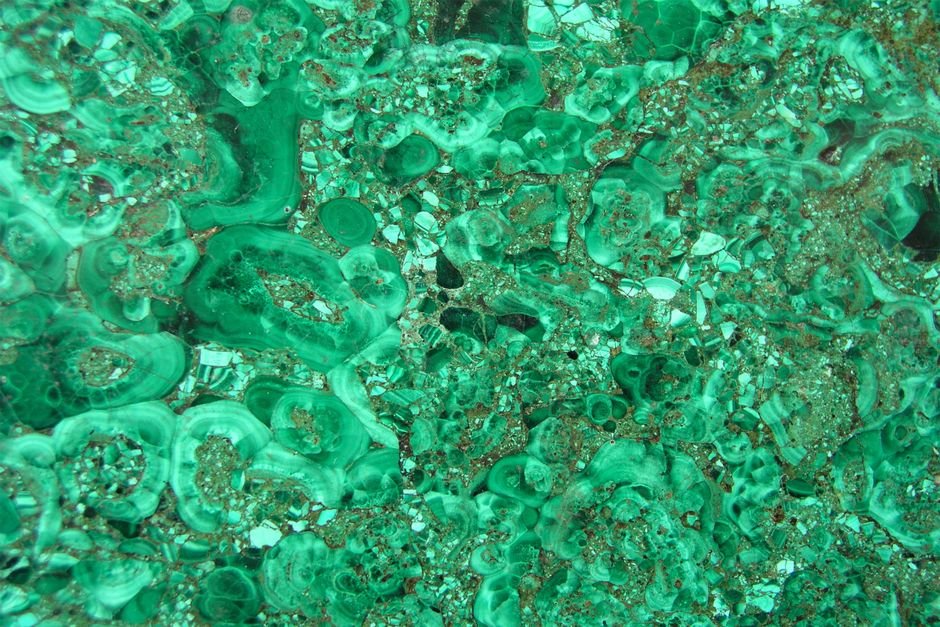
Your malachite is dull because the polish has been chemically attacked, and malachite is unusually easy to attack. It is a copper carbonate hydroxide — Cu₂CO₃(OH)₂ — sitting at just 3.5 to 4 on the Mohs scale, softer than a copper coin and far softer than the quartz grit in ordinary household dust. Water, acid, and the salt and lactic acid in your own sweat all react with it. The polish is a mirror-smooth layer microns deep, so it is always the first casualty: the surface goes flat and faintly waxy, and the green reads greyer and chalkier than you remember.
Nothing has been added to your stone. A layer has been taken off it. The colour underneath is fine — malachite’s green comes from copper in the crystal structure, not a dye, so it does not fade in light the way amethyst does. The surface is genuinely gone, though, and no home treatment puts it back without removing more stone.
The Four Ways Malachite Loses Its Shine
Almost every dull malachite has been through at least one of these, usually two.
Water. Malachite is barely soluble in pure water, so one splash will not dissolve it — but nobody rinses a stone in pure water. Tap water carries dissolved carbon dioxide and chlorine, soapy water is alkaline, and malachite is porous, with microscopic gaps between its growth layers that draw liquid in. Repeated soaking loosens the surface from underneath, lifts any wax fill, and dries to a matte bloom. It also leaches copper ions into the water, which matters below.
Acid. This is the fast one. Malachite is a carbonate and dissolves readily in dilute acids — it fizzes in cold dilute hydrochloric acid, one of the standard field tests for it. Vinegar, citrus juice, descalers, bathroom sprays and most “gentle” jewellery dips etch the polish in one contact, and so do perfume and hairspray left on the surface. So, more slowly, do you: sweat is mildly acidic and salty, so a bead worn against skin is under steady low-grade attack. That is why the beads on the inside of a bracelet dull first.
Abrasion. At Mohs 3.5 to 4, malachite is scratched by nearly everything it meets. Quartz, amethyst, agate and jasper all sit around 7; steel keys are about 5.5; even shelf dust is largely fine quartz. Store malachite loose in a bowl with quartz points and every handling sandblasts it, and thousands of invisible micro-scratches read to the eye as dullness.
Coating wear. Malachite is often treated: wax fills small voids and lifts the lustre, and cheaper pieces are sometimes resin-stabilised. Body heat, hand cream and soap wear that coating off, so a stone that looked glassy in the shop and flat a month later has usually just lost its wax. If yours also seems oddly uniform in pattern or light in the hand, it may not be solid malachite — checking whether a crystal is real rules out dyed howlite and malachite powder set in resin.
Why Banded Malachite Dulls in Stripes
Malachite grows in layers — rounded botryoidal masses and stalactitic columns — and sawing them produces the bands and eyes everyone buys it for. Those bands are not just colour changes. They differ in fibre size, density and porosity, because each formed under slightly different conditions.
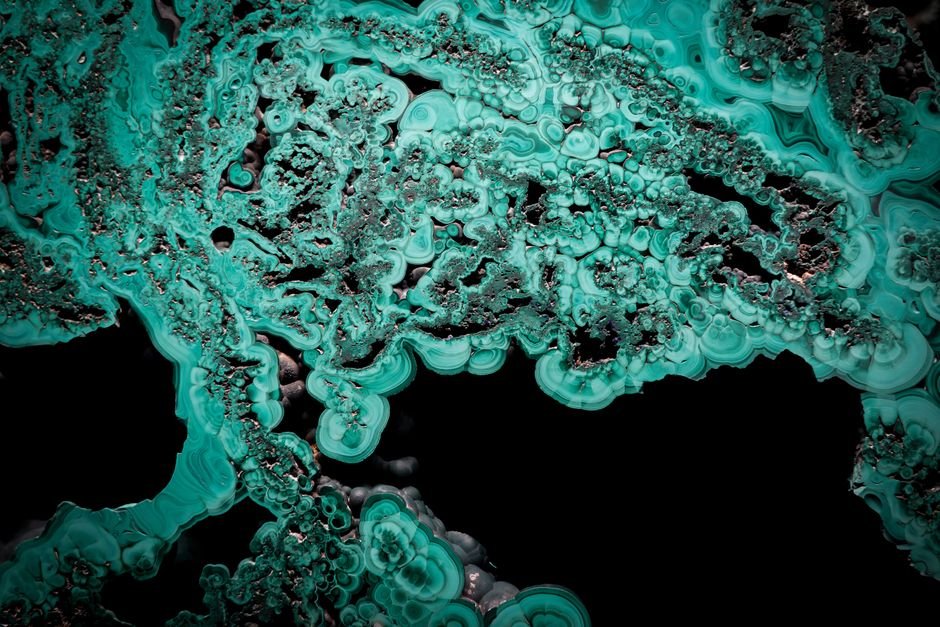
Dense, fine-fibred bands take a hard polish and hold it. Coarser, more porous bands never polished as brightly to begin with, and they give up their shine first. Malachite also has perfect cleavage in one direction, and because the bands curve, that plane meets the cut surface at a different angle in every layer.
So the stone goes patchy rather than evenly matte: glossy dark rings with chalky pale rings between them. That striping is a signature of ordinary surface wear, not of anything unusual happening to your stone.
Malachite Dust: What Actually Warrants Care
Intact, polished malachite is safe to handle. It does not outgas, it sheds nothing through a sealed surface, and copper carbonate is not absorbed through unbroken skin from a solid stone in any meaningful amount. Wearing a malachite pendant is not a health risk, and anyone saying otherwise has overshot the evidence.
The route that matters is powder. Malachite is about 57% copper by weight, and copper dust is a recognised respiratory irritant with its own workplace exposure limits — which is why lapidaries cut and grind malachite wet, with ventilation and a respirator. It was ground into green paint pigment for centuries precisely because it powders so easily.
If your piece is actively shedding — chalking onto your hand, leaving green powder in the dish, flaking at a chipped edge — handle it as a housekeeping problem:
- Do not sand it, file it, or put it on a rotary tool. Dry grinding malachite at home is the one thing genuinely worth avoiding.
- Do not dry-brush it or blow the powder off. Both put the finest particles into the air you are standing in.
- Do not vacuum it with a household vacuum, which returns fine particles to the room.
- Do wipe it with damp kitchen paper, fold the paper inward, bin it, and wash your hands.
- Do keep it off food surfaces and store it in a sealed bag or lidded box.
A shedding malachite is a mess to contain, not an emergency.
Can Malachite Make You Sick?
Four situations, four different answers.
Handling and wearing it: no. Intact polished malachite is safe against skin. Some people get a green mark under a copper-bearing stone or setting — skin acids reacting with copper, cosmetic, and it washes off. Read it as a sign the stone is getting damp, acidic contact and should come off more often.
Breathing or swallowing the powder: this is the real route, covered above. Contain it, don’t grind it, wash your hands.
Elixirs and gem water: don’t make them. This is where the genuine caution belongs. Malachite dissolves readily in dilute acid, and stomach acid is dilute hydrochloric acid. Water left standing on malachite leaches copper ions out of the stone, so drinking it means ingesting a copper salt — and ingested copper salts cause nausea, vomiting and abdominal pain. Use the indirect method instead: the stone sealed in a glass vial, or outside the vessel entirely.
Pets: keep it out of reach. A dog that chews a bead faces both a foreign-body risk and a copper source, and some animals tolerate copper poorly. If a bead is swallowed, call a vet rather than waiting. The same logic applies to soil — copper leaches into ground and is toxic to plants and soil life at concentration, which is why burying a broken crystal is a poor choice for this stone.
Why Malachite Bracelets Break
Four things stack up, and a wrist is the worst place for all of them.
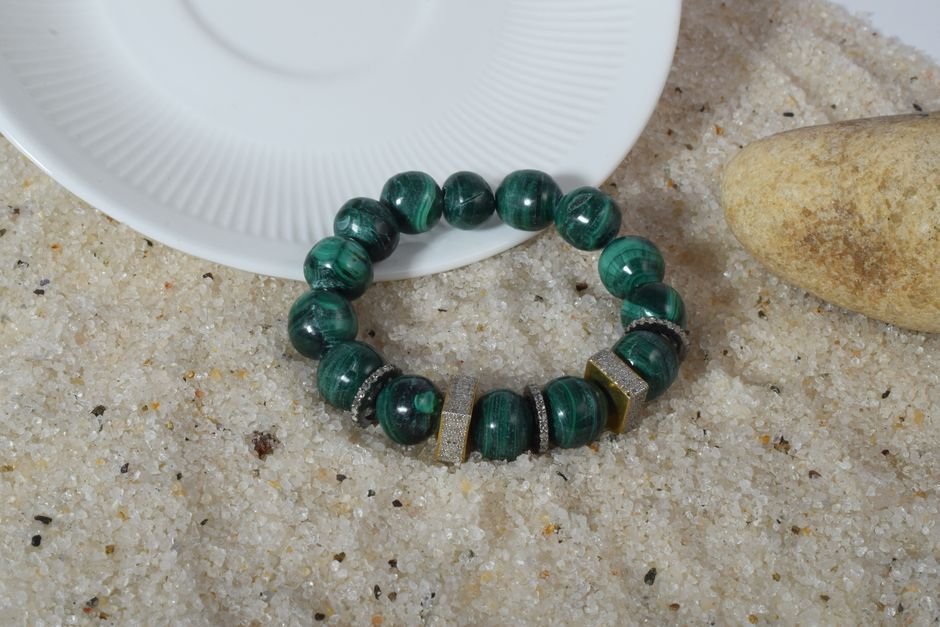
It is very soft for jewellery. Mohs 3.5 to 4 is fine for a display cabinet and marginal for a bracelet. Most stone worn daily sits at 7 or above.
It has perfect cleavage in one direction — a built-in plane of weakness, so a knock aligned with it splits a bead cleanly rather than chipping it.
The banding gives the crack somewhere to go. Layered, fibrous structures part along their layers, so malachite beads usually split along a band rather than shattering.
A drilled bead is thinnest where it matters. The hole concentrates stress at the centre, so beads fail around it while the cord stays intact. Sweat and hand cream degrade elastic separately, which is the other reason crystal bracelets snap with no bead damage at all.
Doorframes, desk edges and car doors deliver more force than people realise, and malachite worn every day has a working life measured in a couple of years, not decades.
Can a Dull Malachite Be Repolished?
Yes — by a lapidary, and only by removing material.
A proper re-polish means wet-sanding through progressively finer grits, then a soft lap and a polishing oxide, all under water. It works, and it takes a real layer off the stone: on a thin cabochon or a bead where the pattern sits near the surface, you can lose some of the banding. On an inexpensive bracelet the labour costs more than the piece.
At home your options are narrower than the internet suggests. A dry microfibre buff removes film and skin oil, and sometimes that was all that was wrong. A colourless microcrystalline or carnauba wax restores some gloss — cosmetic, temporary, and exactly what many pieces already had. Anything that re-cuts the surface removes stone, and anything abrasive enough to work will blur the pattern, so skip toothpaste, baking soda, metal polish and rotary tools. If the piece is cracked too, repairing broken crystals sets out where bonding helps.
What a Dulling Malachite Is Taken to Mean
Within crystal healing, malachite is known as an absorber — the stone said to take the hit, and the one most often described as needing frequent cleansing. Dulling and cracking are widely read as it having done its work. The physical account does not cancel that reading, but it does predict the timing: a malachite worn daily on a warm wrist dulls, and the identical piece in a cabinet does not. If yours has broken, what to do with a broken crystal covers both sides.
Looking After Malachite, and the Stones That Behave the Same Way
Malachite is a dry-storage stone. Keep it out of the shower, the pool and the sink, put it on last after perfume and lotion, and take it off first. Clean it with a dry or barely damp cloth and dry it immediately — no soaking, no soap, and never an ultrasonic or steam cleaner, where vibration and heat can fracture it and craze the wax. Store it in its own soft pouch, away from quartz.
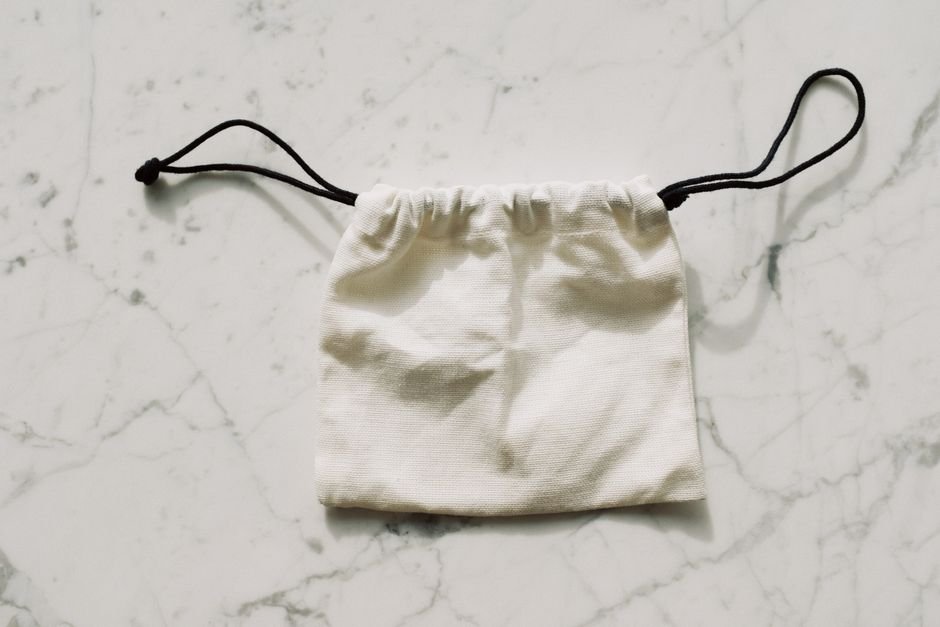
Three relatives need the same handling, for the same chemical reasons.
Azurite is the blue twin, Cu₃(CO₃)₂(OH)₂, also Mohs 3.5 to 4 and often intergrown with malachite. It shares every weakness plus one of its own: azurite alters to malachite over time, so older specimens carry green patches where blue used to be.
Chrysocolla is a hydrated copper silicate. Unless naturally hardened by silica it can be as soft as Mohs 2 to 4 and extremely porous, taking up liquid faster than malachite.
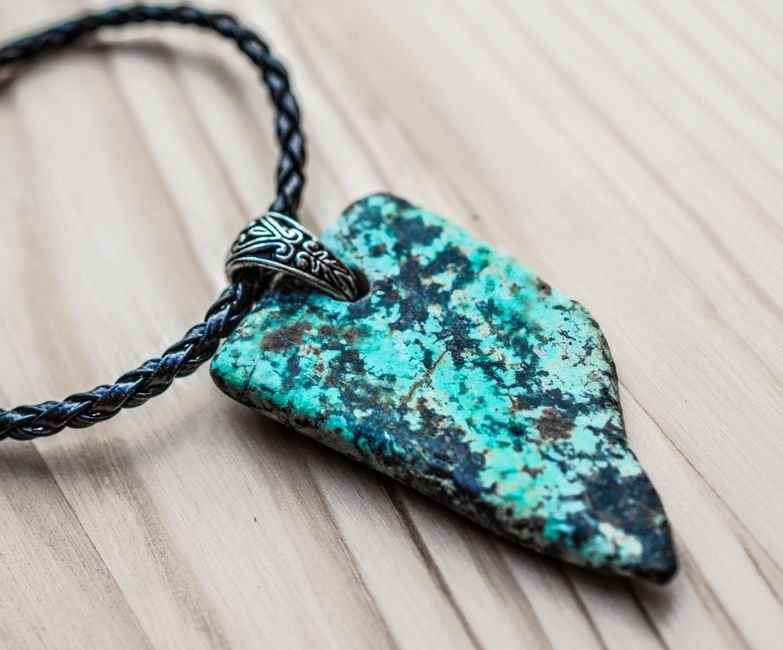
Turquoise is a hydrated copper aluminium phosphate at Mohs 5 to 6 — harder, but porous enough that skin oils and sweat famously turn it green over years of wear. Same family, same advice: keep it dry.
Questions About Dull and Damaged Malachite
Can I rinse malachite under the tap for a few seconds?
A brief rinse and an immediate thorough dry will not destroy a healthy polished piece, but there is no reason to do it. Water gives you nothing a dry cloth cannot, and it is the habit rather than any single rinse that dulls a stone.
Is malachite safe to wear every day?
Safe, yes — an intact polished piece is not a health hazard. Wise, no. Daily wear means continuous sweat, friction and impact, the fastest route to a dull, chipped stone. Taking it off for washing up, showering and exercise extends the polish enormously.
Does dull malachite mean it absorbed too much negativity?
That is the reading many people hold, and it is a genuine part of crystal practice. It sits alongside rather than instead of the physical account: the polish is a thin, chemically vulnerable layer on a soft carbonate, and it goes first because it is what everything touches.
Why did my malachite break where there was no visible flaw?
Because the weakness was structural rather than visible. Perfect cleavage and layered banded growth give a crack a ready path through material that looks solid.
Sources: Malachite — Wikipedia · Malachite — Geology.com · Copper toxicity — Wikipedia